
Guides Irrigation
Drip irrigation systems: parts, layout and upkeep
A drip irrigation system runs water through a filter and a pressure regulator into tubing, then out through emitters at each plant. UGA Extension says the water must be as clean as drinking water to keep emitters from clogging, and that drip typically runs daily or every other day in the growing season.
Updated November 16, 2026
Where drip fits in a yard, and Georgia's rules for running it, are on our irrigation webpage. This guide takes the system apart. UGA's bulletins don't give emitter spacing or counts, so those numbers come from Colorado State Extension and are marked as Colorado's.
What are the parts of a drip irrigation system?
UGA Extension's home vegetable garden circular counts five major components: a water filter, a pressure reducer, a pressure gauge, a header pipe and the drip lines.
For a permanent system, Colorado State Extension puts the equipment in this order from the water source: a backflow prevention device, a control valve, the filter, then the pressure regulator. UGA's bulletin on irrigation for lawns and gardens describes a system as emitters, lateral lines, main lines and a control station.
How much water does an emitter put out?
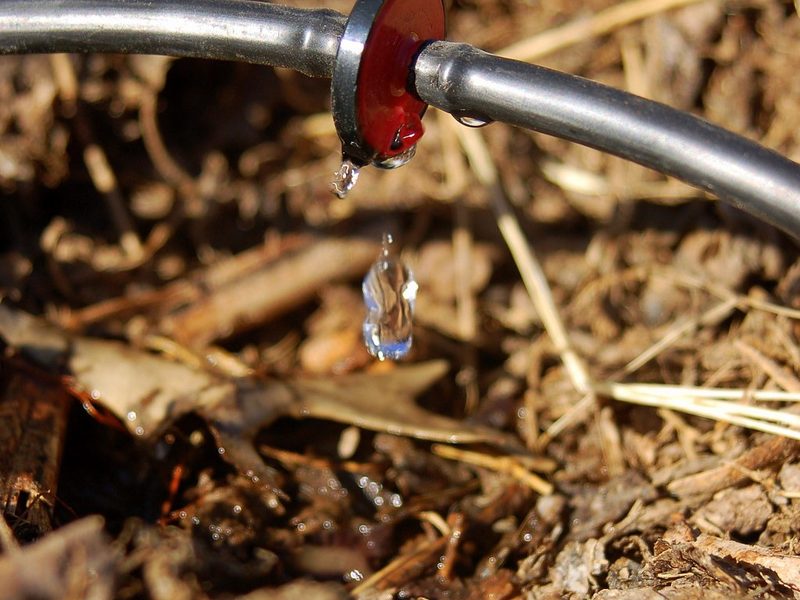
Not much. UGA says point-source emitters are usually fixed at 1/2 to 2 gallons per hour, and 1 gallon per hour is the most common rate.
For plants set close together, Colorado State Extension suggests emitter tubing, which has the emitters built into the line. It says those in-line emitters are self-flushing and clog resistant as long as the water's filtered with 200 mesh filters.
How far apart should emitters go?
That depends on the soil, since water spreads sideways farther in some soils than in others. Colorado State Extension's spacing is 12 inches apart in sand, 18 inches in loam and 24 inches in clay.
Its starting counts go by plant size. A shrub 1 to 5 feet tall, or a small tree that'll stay under 15 feet, begins with two 1-gallon-per-hour emitters 12 inches from the base, and a shrub 5 feet or larger may need three.
For new plantings, it says to put the emitters over the root ball, and larger plants or plants that use more water need more emitters.
How long should drip irrigation run?
The sources don't agree. Next to UGA's daily or alternate-day schedule, Colorado State Extension says systems are generally designed to run one hour a week once plants are established; sandy soil after planting, or plants that need steady moisture, may need twice a week.
Colorado State calls its own numbers a rough first guide and says to check the soil moisture at the plant's root depth the following day.
How do you keep emitters from clogging?
Filter the water, and keep the filter clean. UGA's bulletin lists sand, cartridge and disk filters and screens of 100 to 200 mesh, and says a small screen filter sized for the flow is usually enough when the system runs on the same water as the house. A pond or creek supply needs a more substantial filter.
Its upkeep schedule has three parts. Clean filters and screens periodically, by hand or with built-in backflushing. Flush weekly, twice a week or twice a month, depending on water quality and filter size. Once a year, open the end of each lateral line to flush out the sediment.
UGA's vegetable garden circular gives the reason: sediment in a clogged filter makes the emitters down the line perform poorly or become blocked, and it says to check connections and emitters frequently.
Should drip lines go under mulch?
Colorado State Extension says drip tubing can be a trip hazard, especially for dogs and children, and is less of one when it's covered with mulch and fastened with wire stakes every 2 to 3 feet. Mulch for the beds themselves is on our mulch and pine straw webpage.
Timers, fabric and water savings
Does a drip system need a timer?
It doesn't have to have one. UGA Extension's home vegetable garden circular says a battery-operated water timer can also be added to help automate the system, so it's an extra for a garden system.
Does drip tubing go above or below landscape fabric?
Above it. Colorado State Extension says to install the mainline above weed fabric and under mulch, which keeps it out of sight and keeps it from becoming a trip hazard. That's advice written for home gardens in Colorado.
How much water does drip irrigation save?
UGA Extension's vegetable garden circular says drip irrigation uses 75% less water than an overhead system. It's a comparison for a vegetable garden against overhead sprinklers, not against every kind of system.