
Services Drainage and grading
Yard drainage solutions in Rome, GA
Yard drainage solutions in Rome, GA for standing water, soggy low spots, washouts and runoff that heads for the foundation: regrading, swales, downspout lines, catch basins, dry creek beds and rain gardens.
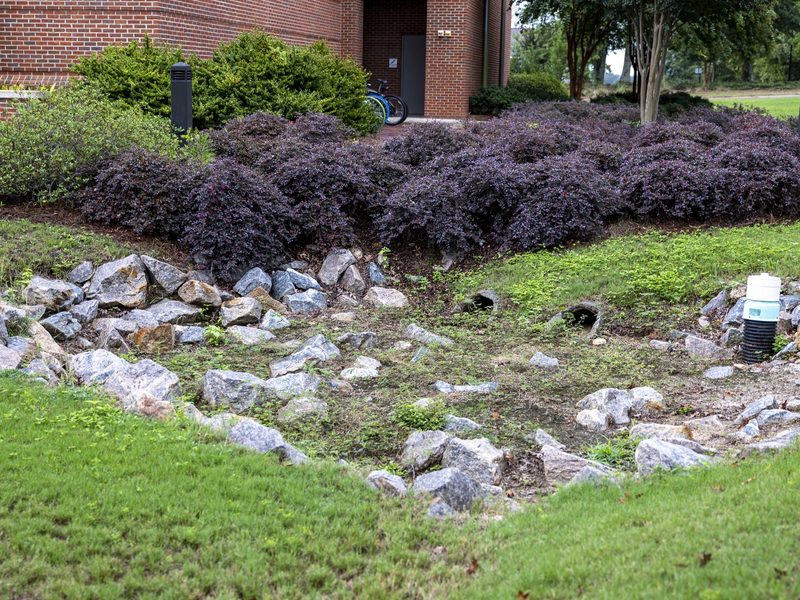
The right drainage solution starts with where the water comes from. In a yard it comes off the roof, down a slope or up out of the ground, and each source calls for a different fix. So the first step is watching where the water runs and where it stops.
Finding the right drainage solution
Most fixes fall into a few families, each matched to a problem:
- Water heading for the house: regrading so the ground falls away from the foundation.
- Roof water dumped at the corners: downspout extensions or buried downspout lines.
- Runoff crossing the yard from uphill: a swale or curtain drain that steers it around.
- A low spot that holds water: a French drain or catch basin to collect it and carry it off.
- Water you'd rather keep on site: a rain garden that lets it soak in.
Why does water stand in the yard?
Slow soil is one reason. In the Atlanta region, the regional water planning district says clay soils take in water slowly, up to half an inch an hour, so a heavy storm can outpace the ground.
Then there's grade. Georgia's residential code expects every lot to be graded so surface water drains away from the foundation, and where walls, lot lines or slopes get in the way, it calls for drains or swales. A yard that tilts toward the house does the opposite of what the code asks.
Downspouts, swales and catch basins
Roof water is often the easiest win. University of Minnesota Extension goes as far as saying a downspout without an extender or splash block is worse than no downspout at all, since it drops roof water right at the foundation.
A swale is a shallow, gently sloped channel that guides water around a house or across a yard to a better spot. A catch basin works at a single low point: water drops through a grate into a box, and a pipe carries it away.
Dry creek beds and rain gardens
Some drainage fixes look like landscaping on purpose. A swale lined with stone is sometimes called a dry creek bed, Ask Extension notes. It carries water during a storm and looks like a stream of river rock the rest of the time.
A rain garden does the opposite job. Instead of moving water off the property, it gives runoff a planted low spot to soak into. UGA Extension's rain garden bulletin puts one at least 10 feet from a building foundation, so the water soaks in away from the house.
When the fix calls for a buried pipe, it's a French drain; when the ground itself needs reshaping, it's yard grading; and when a slope needs holding back, it's a retaining wall.
Slopes, rain gardens and swales
How far should the ground slope away from my house?
Georgia's residential code says the ground should fall at least 6 inches within the first 10 feet from the foundation, and paved surfaces within 10 feet should slope at least 2 percent away. Where a lot line or wall makes that impossible, the code calls for drains or swales instead.
Will a rain garden fix standing water?
It can help if the ground drains. UGA Extension recommends rain gardens 6 to 8 inches deep, with water ponding no more than 48 hours after rain stops. A spot that stays soggy for days needs a drainage fix first.
What's a bioswale?
A shallow, planted channel. UGA Extension's Georgia Green Landscapes program describes vegetated swales and bioswales as a way to move water across a landscape and let it soak in, which helps prevent stormwater problems and erosion.