
Services Drainage and grading
Lawn leveling and yard grading in Rome, GA
Lawn leveling and yard grading in Rome, GA: filling low spots, smoothing bumpy turf, sloping the ground away from the house and covering bare soil so it holds through the next storm.
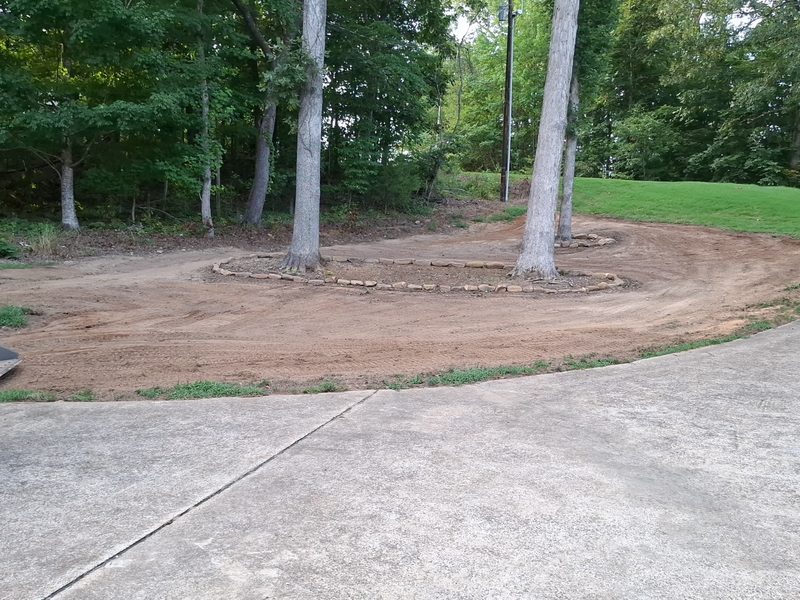
Lawn leveling fixes the small stuff: the ankle-turning dips and the bumpy patches that scalp under a mower. Yard grading is the bigger job, reshaping the ground so water runs away from the house instead of toward it. Some yards need both.
Lawn leveling for bumps and low spots
For an established lawn, University of Wisconsin Extension says small topdressing additions to selected spots can help correct constantly wet areas or particularly bumpy lawns. Bigger dips and humps are where leveling turns into regrading.
Leveling helps with puddles, too, since low spots are where they form.
Yard grading that sends water away
UGA Extension's lawn establishment guide describes rough grading as three jobs: sloping the grade away from building foundations, reducing severe slopes and filling low-lying areas.
How much slope? Near the house, Georgia's residential code asks for at least 6 inches of fall in the first 10 feet. Across the rest of a lawn, UGA says a 1 to 2 percent slope away from buildings, a 1- to 2-foot drop over 100 feet, gives good surface drainage.
Georgia 811 counts grading as mechanized digging, so buried lines get marked before the ground is reshaped. Once a lot of soil has been moved, UGA suggests wetting the area. Water firms the seedbed and shows any low spots, which can be fixed before anything is planted.
Erosion control on bare ground and slopes
Freshly graded soil is at its most exposed before anything grows on it. For seeded ground, UGA recommends a thin layer of mulch such as pine or wheat straw, which helps prevent erosion and holds moisture for the seed. On bigger jobs, a silt fence keeps soil from washing off the site; EPA describes it as a temporary sediment barrier made of porous fabric.
A slope too steep to hold with grass is a job for a retaining wall.
Is your yard near a creek or river?
Water nearby changes the rules. Georgia's erosion law restricts land disturbance in a buffer along creeks, streams, rivers and most lakes and ponds, 25 feet wide in most places by the account of the state Department of Community Affairs, and wider on trout streams. DCA's Backyard Buffers guide says homeowners may thin or trim vegetation there if water quality and habitat are protected, but significant land disturbance takes a variance.
Rome adds its own layer. Where a land disturbance permit is needed, the city's permit packet says properties within 200 feet of the banks of the Etowah, Oostanaula or Coosa River need approval from the River Overlay District Committee.
Once the ground is shaped, a new lawn goes on top: see sod installation or hydroseeding. Water that grading alone won't solve calls for drainage work.
Leveling, grading and permits
Will grading stop water running toward my house?
That's what rough grading is for: UGA's lawn guide lists sloping the grade away from building foundations as its first job. Water arriving from a neighbor's lot or a downspout may need drainage work as well.
What is topdressing a lawn?
Spreading a thin layer of soil or sand over the turf, the method Wisconsin Extension's lawn guide describes for evening out bumpy ground.
Do I need a permit to grade my yard?
For small home landscaping, usually not under state law: Georgia EPD's guidance exempts minor work such as individual home landscaping from the state erosion law. Local rules can be stricter, so ask Rome-Floyd County Building Inspection, or your own city or county outside Rome. Work near a stream or river has its own limits.