
Services Lawns and sod
Lawn care service in Rome, GA
Lawn care service in Rome, GA covers the mowing, edging, trimming and cleanup, on a schedule that speeds up as the grass grows in summer and slows down in fall.
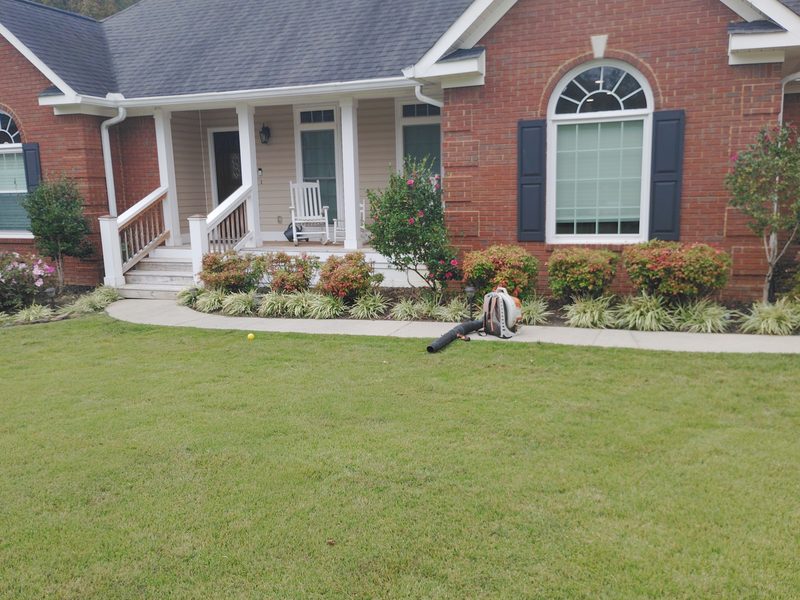
A good lawn comes from small things done on time: mowing at the height the grass needs, never taking too much at once, keeping the blades sharp and letting the season set the schedule. We handle the mowing, edging, trimming and cleanup.
Mowing heights by grass type
Georgia lawns aren't all one grass, and the right mowing height depends on which one you've got. UGA Extension's numbers:
- Bermudagrass and zoysiagrass: 1 to 2 inches, with hybrid bermudagrass a little lower at 1 to 1.5.
- Centipedegrass: 1 to 2 inches.
- St. Augustinegrass: 2 to 3 inches.
- Tall fescue: 2 to 3 inches, raised half an inch in hot weather.
Bermudagrass is adapted statewide, UGA's turf page says, and tall fescue is best adapted to the Piedmont, where it's used for home lawns and to hold soil. UGA also reports an explosion in zoysiagrass use across Georgia. If you're not sure which grass you have, it's worth knowing before the first cut.
How short should you cut grass?
UGA's rule is to never remove more than a third of the blade height in one mowing, because cutting more stresses the grass. In a fast-growing stretch, that means mowing more often instead of cutting lower.
Sharp blades count too. UGA says mower blades should always be kept sharp, since dull blades can make a lawn deteriorate.
Should you leave the clippings?
UGA Extension calls it grasscycling: leaving clippings on the lawn so they break down and return nutrients to the soil. UGA's composting circular says they only need collecting when the grass has grown very tall or the clippings would blanket the lawn.
Lawn care service also covers edging along walks and drives, trimming around beds and trees, and blowing clippings off the pavement.
Lawn care through the seasons
Warm-season grasses like bermudagrass and zoysiagrass grow hard through the summer and slow down as fall cools off, and the mowing slows with them. Tall fescue keeps a different calendar, and so do lawn fertilization and weed control.
Fall brings the leaves, which leaf removal clears, and a compacted lawn can get core aeration while it's growing. Hedge trimming keeps the shrubs along the house in shape, and offices, churches and HOAs get the same mowing through commercial landscaping.
Mowing through the year
How often should a lawn be mowed?
Often enough that each cut takes no more than a third of the blade, which is UGA's rule. In the weeks when grass grows fastest, that means mowing more often; in a dry spell or late fall, less.
Why is my St. Augustine lawn slow to green up?
UGA calls St. Augustinegrass a cold-sensitive species that can be slow to recover in spring after an abnormally cold winter, and says it's best adapted to the middle and lower part of the state, though many Atlanta-area lawns have it.
Can I compost grass clippings after a weed treatment?
UGA's composting circular says to leave clippings on the lawn for at least three mowings where herbicides have been applied, instead of collecting them for compost or mulch.