
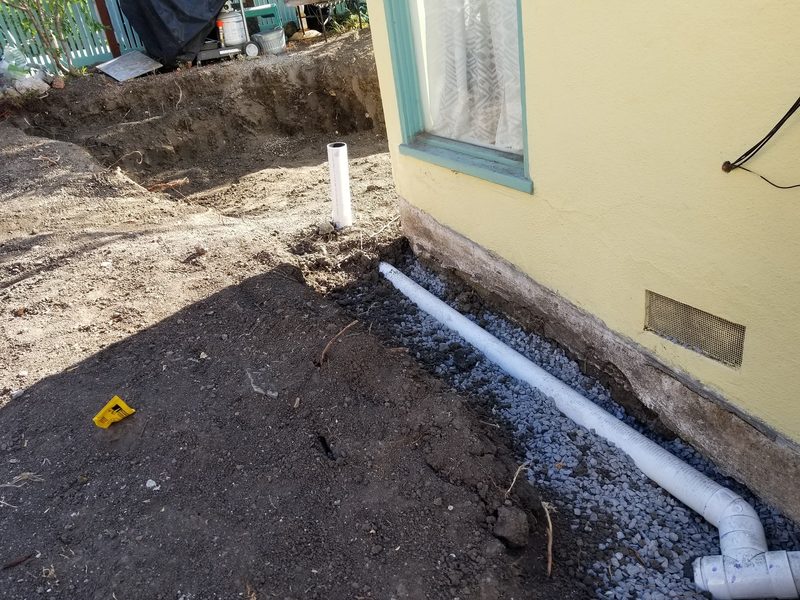
A French drain is one fix for water that sits where you don't want it: the soggy strip beside the driveway, the low corner that stays wet for days after a storm, the spot where every downspout seems to empty. It catches that water underground and carries it off before it can sit.
French drain installation, step by step
An Ask Extension answer from a Michigan State University Extension volunteer describes a typical build, starting from a perforated pipe surrounded by gravel and lined with sturdy landscape fabric:
- Dig the trench along the path the water needs to take, sized to the pipe.
- Line it with landscape fabric on all sides.
- Lay a bed of gravel in the bottom, then set the perforated pipe on it.
- Surround the pipe with gravel and finish the top to suit the yard.
The pipe slopes the whole way so water moves by gravity, the same rule the hardscape industry's retaining wall guide sets for the drain behind a wall. So the outlet has to be chosen before the trench is laid out, and Georgia 811 gets buried lines marked before a machine digs; it encourages homeowners to call even for small hand digging.
Where does the water go?
This question decides whether a French drain works. Per Ask Extension, redirected runoff has to go to a suitable outlet, or the problem just moves downhill.
Depending on the lot, that outlet might be:
- a lower spot in the yard where the pipe can daylight, or open to the surface;
- a storm drain system, where tying in is allowed;
- a dry well, which UGA Extension describes as a pit of washed rock that holds stormwater until it soaks into the soil.
Clay soil takes water in slowly, so a dry well doesn't suit every yard, and pointing the pipe at a neighbor's lot just hands them the problem.
French drains, curtain drains and catch basins
The names get mixed up. A French drain collects water along its whole length. A curtain drain uses the same idea as a barrier, catching water as it moves toward an area and steering it around. A catch basin is a box with a slotted grate on top and an outlet at the bottom, and it can be paired with a French drain to clear standing water at a low spot.
Not every wet yard needs a buried pipe. Sometimes the answer is a swale, a downspout extension or a regrade; our drainage solutions webpage covers those, and yard grading covers reshaping the ground. The drain behind a block retaining wall is itself a kind of French drain: the industry's wall guide wraps its pipe and gravel in fabric as a filter.
Depth, downspouts and fabric
How deep is a French drain?
Ask Extension describes a standard trench as about 1.5 feet deep and 10 to 12 inches wide, depending on the pipe size, usually 4 to 6 inches, and how deep the drain needs to be. The outlet and the slope to it set the final depth.
Can downspouts connect to a French drain?
They can. Ask Extension notes that downspout and sump pump pipes can be tied into a French drain, and a catch basin can be added to help clear standing water. The more water feeding the drain, the more the outlet matters.
Why does a French drain need landscape fabric?
To keep soil out of the stone. Ask Extension's answer lines the trench on all sides with landscape fabric, and the hardscape industry's retaining wall guide wraps pipe and gravel in fabric so it works as a filter. Without it, silt can work into the gravel over time.