
Services Hardscapes and outdoor living
Retaining walls in Rome, GA
Retaining walls in Rome, GA hold back a slope and give you level ground to use. A block wall that lasts has a buried base, drainage stone and a drain pipe behind it to limit the water pressure that builds up against it.
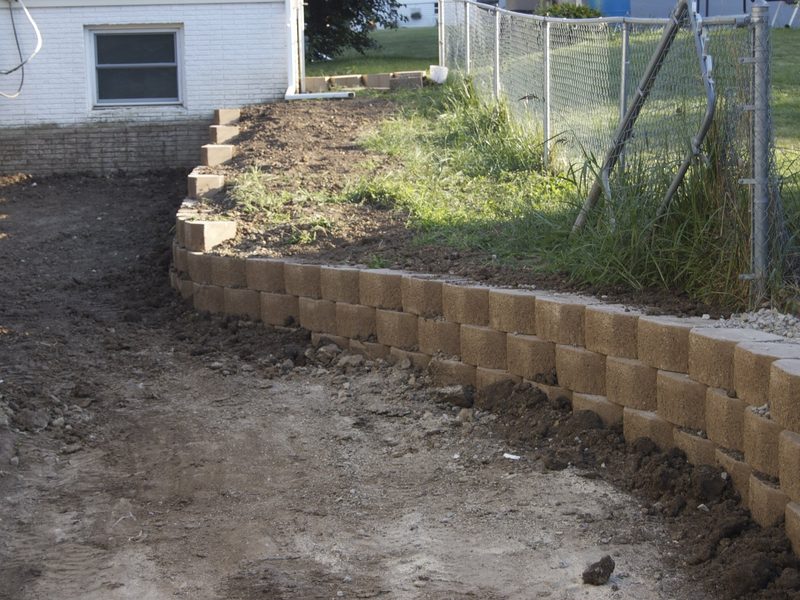
A bank that sheds mud onto the driveway can become a planted terrace, and a backyard that falls away from the house can get a flat spot for a patio. Retaining walls are how a sloped yard in Rome becomes one you can use, and a good one looks like part of the yard.
Retaining walls for a sloped yard
A segmental block wall is built from interlocking concrete units stacked without mortar, and it's the type the industry's design and inspection guides are written around.
When a wall has to go taller than a plain stacked wall can, the same kind of blocks get reinforced with layers tied into the soil behind them.
What's behind a block wall that lasts?
The Concrete Masonry and Hardscapes Association's guides spell out what goes in behind and below the blocks:
- A buried base. The bottom course sits below grade, with soil in front of the wall never less than 6 inches deep.
- Drainage gravel. Free-draining stone fills at least 12 inches behind the blocks, so groundwater can get out and less pressure builds up.
- A drain pipe. Perforated or slotted pipe runs along the base, sloped so water flows out by gravity to daylight or a storm drain. The guide says not to use sock-wrapped pipe.
- Batter. Each course sets back from the one below, so the wall leans into the slope. More batter means more stability.
- Reinforcement, when needed. Taller walls, or walls with a slope, a driveway or another load above them, are built as reinforced soil walls, with geogrid layers tied into the soil behind.
When does a wall need an engineer?
Georgia's residential code draws two lines. Section R404.4 calls for walls that aren't supported at the top and retain more than 48 inches of unbalanced fill to be designed for stability.
Walls over 24 inches that hold back a load beyond the soil itself, such as a driveway or a building, have to be designed to accepted engineering practice against overturning, sliding and water uplift.
In practice, that means a short garden wall is a straightforward build, and a tall wall under a parking pad is a different project with drawings.
Walls that work with drainage and steps
A wall often solves two problems at once. If water runs off the slope behind it, deal with the drainage too; behind the wall, the industry's guide allows the drain pipe and gravel to be wrapped in fabric as a filter, which it calls a French drain. If people need to get from one level to the other, stone steps can be built right into the wall.
Bare slopes that aren't steep enough for a wall can be held with grading and erosion control instead. For permits inside Rome, Rome-Floyd County Building Inspection's FAQ is the place to check.
Walls, permits and drainage
How do you build a retaining wall on a slope?
The industry's guides call for building from the bottom up, with the base course buried in the ground, at least 12 inches of drainage gravel behind the blocks and a drain pipe at the base that carries water away. Each course steps back a little from the one below. The block maker's instructions or the wall's engineer set the exact details, and buried lines get marked through Georgia 811 before the dig.
Do I need a permit for a retaining wall in Rome?
Under Rome-Floyd County Building Inspection's FAQ, a wall no more than 4 feet tall, measured from the bottom of the footing to the top, that doesn't hold up a structure, a fence or any other load needs no building permit. Most other retaining walls do. Other towns set their own rules, so check with yours.
What does the gravel behind a retaining wall do?
It gives groundwater a way out. The industry's guide puts free-draining gravel behind the blocks to carry off groundwater and limit the hydrostatic pressure against the wall.