
Services Hardscapes and outdoor living
Paver walkways and stone steps in Rome, GA
A paver walkway, a flagstone path or a set of stone steps in Rome, GA needs a compacted base, a width that fits how you walk and steps that are easy on knees.
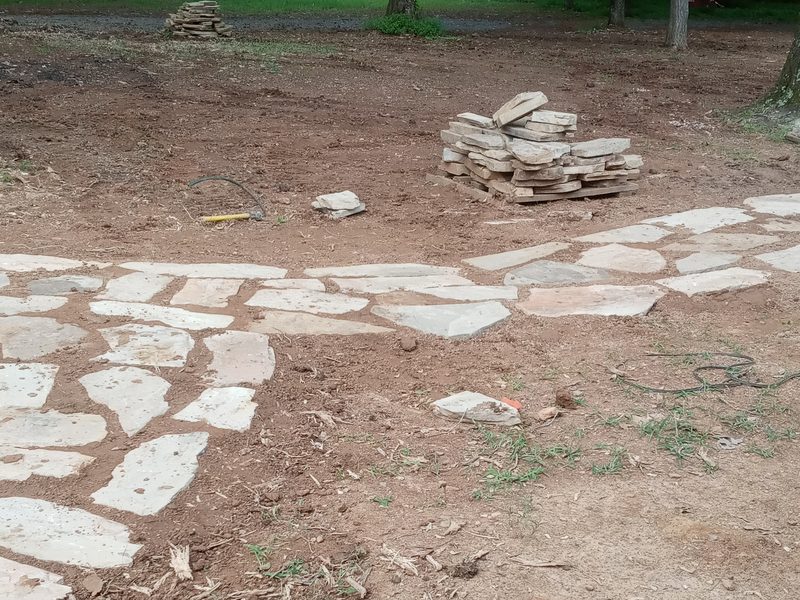
No more cutting across wet grass to the car, no more stepping stones that wobble: a paver walkway is the kind of project you notice every day once it's done. Around Rome we build walks from pavers, flagstone and stepping stones, and stone steps where the yard changes level.
A paver walkway wide enough to share
Width is the first decision. University of Missouri Extension says a walk has to be at least 4 feet wide for two people to walk side by side, and 5 feet for wheelchair access.
Under the surface, a paver walk gets the same treatment as a patio. Oregon State Extension's guide calls for a base of crushed rock, such as 3/4-minus gravel, compacted before the bedding sand and pavers go down. That base is what keeps a walk flat.
Flagstone, pavers or stepping stones?
Each has its place:
- Pavers give a smooth, even surface, a good fit for a main walk, a path that carries a wheelbarrow, or anyone unsteady on their feet.
- Flagstone has the natural look. One way to set flagstone is in a bed of granite fines, as NC State Extension's design chapter shows.
- Stepping stones suit a side path through a bed, where a full walk would be too much.
Mixing them works too: a paver walk to the front door, flagstone around to the back gate.
How should outdoor steps be built?
Outdoor steps need more room than indoor ones. UNH Extension recommends wider treads and shorter risers outside, so steps stay safe in wet or icy weather.
For steps that serve the house, Georgia's residential code sets limits worth knowing: treads at least 10 inches deep, risers no taller than 7 3/4 inches and a stairway at least 36 inches wide. Garden steps out in the yard fall outside that code section; for those, UNH's advice applies: deeper treads and lower risers than you'd build indoors.
A single step is its own hazard. NC State Extension warns that people trip and fall where an elevation change is one step or less, so a lone step needs to be obvious: a change in material, a light, or a gentler ramp instead.
Steps can be built into a retaining wall, a walk can lead out to a paver patio, and path and step lights from landscape lighting make both safer at night.
Width, base and steps
How wide should a front walk be?
University of New Hampshire Extension says a home's main walk should be at least 4 feet wide. A side path through a bed can be narrower.
How do you lay pavers for a walkway?
The same way as a patio, just narrower: dig out, compact a crushed-stone base, set an edge, screed bedding sand, lay the pavers and sweep sand into the joints. Oregon State Extension's guide names crushed rock such as 3/4-minus gravel for the base, and buried lines get marked through Georgia 811 before any machine digging.
Do outdoor steps need a light?
Georgia's residential code calls for a light at the top landing of exterior stairways that serve a house. Garden steps out in the yard are a judgment call, and a few low-voltage step or path lights usually solve it.