
Guides Fire pits, patios and outdoor living
Stepping stones that stay put
Stepping stones make a path without paving one: flat stones set flush with the ground, spaced to the stride of whoever walks them. Set on packed soil and a bed of sand, they stay put instead of sinking, rocking or catching the mower.
Updated November 15, 2026
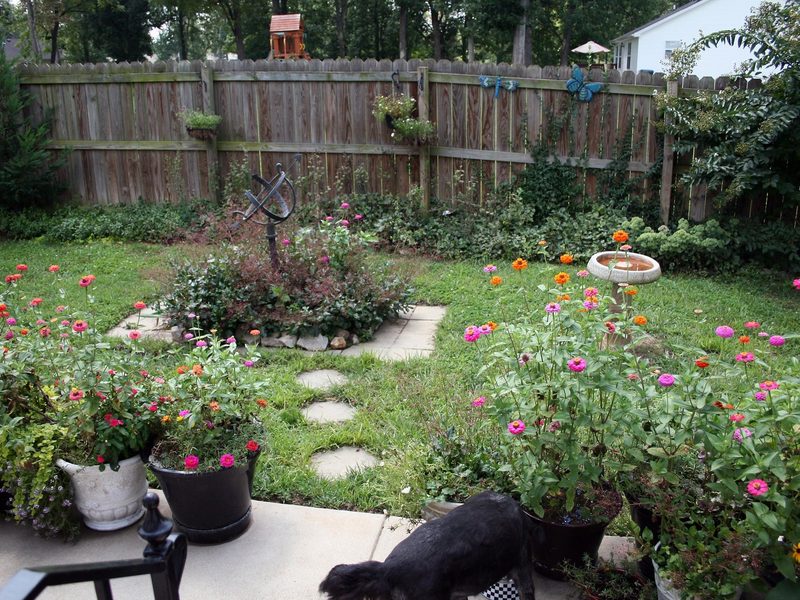
Stepping stones carry a path across the lawn to a gate, through a wide bed or out to a bench at the back of the yard. Spacing comes first, then the setting.
How far apart should stepping stones be?
As far apart as the people using them step. NC State University's Natural Learning Initiative, which designs outdoor play and learning spaces for children, sets its stones 12 to 18 inches on center, close enough for a child to step easily from one to the next. Adults take longer strides, so a path for grown-ups needs them farther apart.
On center means from the middle of one stone to the middle of the next. At the same spacing, bigger stones leave narrower gaps and smaller stones leave wider ones.
The dependable way to get it right is to lay the stones out on the ground before digging. UF Extension's walkway guide says to plan the path before laying the stones, and to leave space between them so water can flow through.
For a main route, like the walk to the front door, a continuous surface is easier on everyone, and our walkways and steps webpage weighs pavers, flagstone and stepping stones against each other.
Setting stepping stones so they don't sink or wobble
Most of the work happens under the stone. Here's the Natural Learning Initiative's method, step by step:
- Cut and mark the soil around the edge of each stone with a garden trowel or shovel.
- Dig as deep as the stone is thick, plus an inch for sand. A 2-inch stone gets a 3-inch hole.
- Level and compact the soil at the bottom of the hole.
- Spread an inch of sand, then level and compact it.
- Set the stone so its top sits flush with the lawn, mulch or soil around it.
- Fill the gap between the stone and the surrounding soil with sand, and compact it to an even surface.
Flush is the detail that counts most in a lawn. UF Extension says stepping stones should be level and low enough to mow over, so the mower rolls across the path without catching a raised edge. If a stone starts to rock later, lift it, level the sand again and reset it.
Why do stepping stones get slippery?
In a damp spot, the culprit may be nostoc, a jelly-like organism. Clemson Extension says it can form on wet concrete or gravel sidewalks and cause a slipping hazard if it isn't managed.
Nostoc is more a sign than a cause. Clemson says it's filling in space where grass and other plants won't grow, such as areas with compacted soil, too much moisture or high soil phosphorus. A path that stays slick usually runs through ground that stays wet.
So the lasting fix starts with the water. Where a low spot holds rain for days, yard drainage comes first; where the trouble is only shade, a sunnier route for the path, or a ground cover that takes shade, may be the simpler answer.
Shade, thickness, beds and rain
Why won't grass grow around my stepping stones?
Shade is a common reason. UGA says lawn grasses need 4 or more hours a day of full to filtered sun, so a path under a dense canopy often ends up in bare ground.
How thick should stepping stones be?
NC State's Natural Learning Initiative says stepping stones should be smooth and flat, so they don't become tripping hazards, and 1 to 2 inches thick, depending on the stone, so they don't crack. Thin, uneven pieces are the ones that end up rocking or breaking.
Can stepping stones cross a flower bed?
Yes, and the bed benefits. Colorado State University Extension says stepping stones can allow easy access through larger garden spaces and prevent soil compaction, so there's a place to stand while weeding or pruning without packing down the soil around the plants.
Do stepping stones let rain soak in?
They can. UF Extension counts stepping stones among the pervious path materials, along with mulch, gravel, porous concrete and pervious pavers. A solid concrete walk, by contrast, sheds the water off to its edges.