
Guides Retaining walls and slopes
Retaining wall blocks and how they stand
Retaining wall blocks are concrete units made to be dry stacked into a wall, with no mortar and each course locked to the one below. They aren't the same as the concrete block in a foundation, and that difference decides how the wall gets built.
Updated November 15, 2026
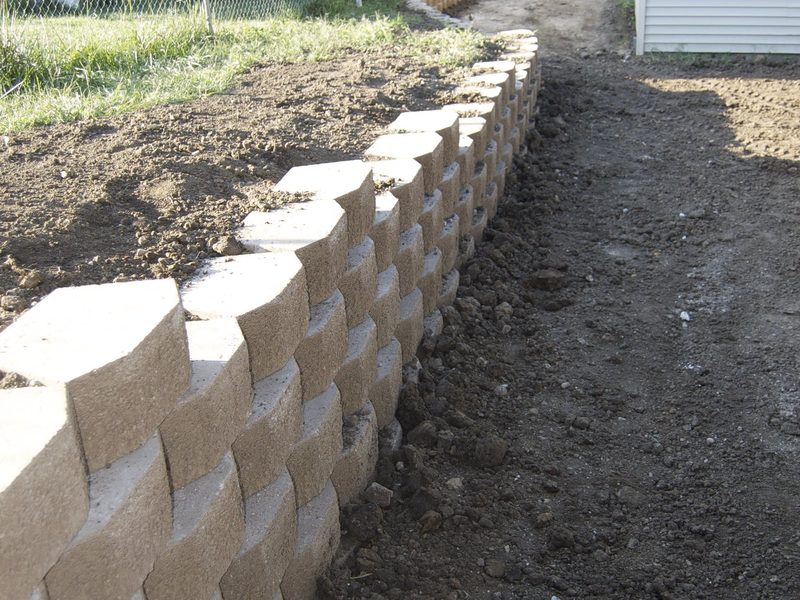
What retaining wall blocks weigh and how they lock to their neighbors decide how the wall stands, while the maker's own guidance sets how tall a given block can go. CMHA, the concrete masonry and hardscapes trade group, says a segmental system's capacity varies with unit size, shape and batter, and that the manufacturer's recommendations for its own units should be followed.
Types of retaining wall blocks and how they lock
A block wall stands by weight. CMHA defines segmental retaining walls as gravity walls that rely mainly on their own mass for stability, so a heavy block isn't a drawback; it's the point.
Each course also has to grip the one below it. CMHA lists the ways units do that: shear keys, leading or trailing lips, clips, pins, or compacted columns of gravel in open cores.
Hollow blocks are built to be filled. When CMHA figures a segmental wall's weight, it counts the units plus any aggregate core fill, and whether the units are solid or core-filled changes how tall a gravity wall can go.
How tall can a block wall go without reinforcement?
CMHA says unreinforced segmental walls typically can be built up to 3 to 4 feet high, or less where the soil is poor or a load such as a driveway sits above the wall. That's the trade group's typical range for a plain stacked wall, not a legal limit.
Soil is the variable a block can't change. The same block that stands at the top of that range on firm ground may need to stop short of it on soft, wet clay.
Taller walls get layers of geogrid reinforcement, covered step by step in the how to build a retaining wall guide. The heights at which Georgia's residential code calls for engineering are on our retaining wall webpage.
Retaining wall blocks or concrete block?
They're different systems. A mortared concrete masonry wall, built from the gray block many people call cinder block, sits on a concrete footing, and CMHA says that where freezing is expected, the footing's base belongs below the frost line. CMHA treats a steel-reinforced cantilever wall as a separate type again.
Segmental blocks work differently. CMHA calls segmental walls flexible structures, so their footing doesn't need to go below the frost line as long as the soil underneath can bear the load. They start on a leveling pad of crushed stone or unreinforced concrete instead, which the how-to guide covers.
Natural stone is the other way to dry stack a wall. As LawnStarter puts it, dry-stacked stones are held together with gravity, while wet-laid stones use mortar, the same split between stacked and mortared that separates segmental block from concrete block.
What each kind costs per square foot of wall face is in the retaining wall cost guide, publisher by publisher, with segmental block and cinder block priced on separate lines.
Curves, colors and standards
Can a block retaining wall curve?
Yes. CMHA says curves and other unique layouts can be easily accommodated with segmental retaining wall units, so a block wall can follow the line of a bed, a patio edge or the hillside itself instead of running straight.
Do retaining wall blocks come in different colors and textures?
They do. CMHA says segmental retaining wall units are available in a variety of sizes, shapes, textures and colors, which leaves room to match the wall to the house, a patio or stone already in the yard.
Are retaining wall blocks made to a standard?
Yes. CMHA says the specification for segmental retaining wall units is ASTM C1372, and that units made to industry standards arrive uniform in weight, dimensional tolerances, strength and durability. Ask which standard a block meets before buying.