
Guides Retaining walls and slopes
Retaining wall ideas for sloped Georgia yards
Retaining wall ideas for a sloped Georgia yard can turn one slope into level terraces, and the right mix of material, plants and small touches makes the wall part of the yard.
Updated November 15, 2026
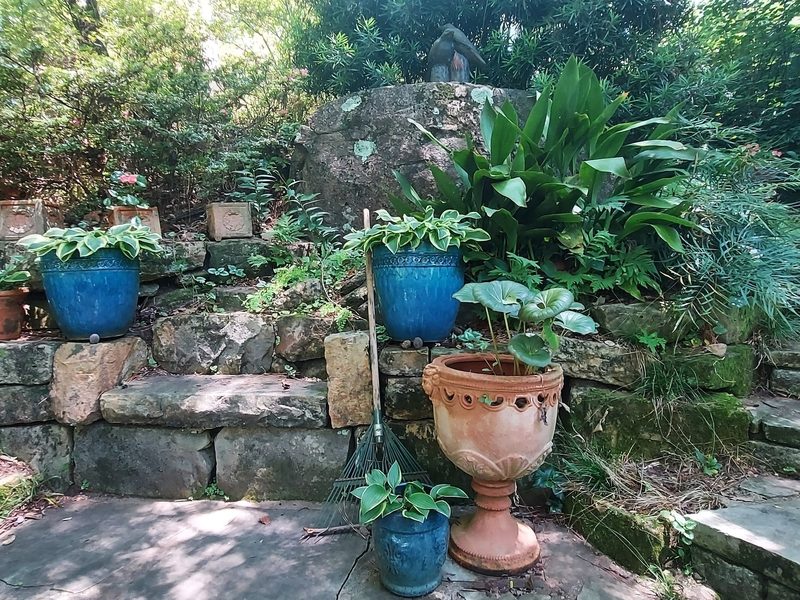
Terracing is the retaining wall idea that changes a yard most: two or three short walls with level ground between them, in place of one tall wall. From there, the material sets the look, whether it's block, natural stone, timber or rock-filled gabions, and plants on the level ground hold the soil and soften the edges.
How steep does a slope get before a wall helps?
UGA Extension's Forsyth County office sorts slopes by grade. Under 5 percent, a rise of 1 foot over 20, is gentle, and it can be planted and managed with little thought for the slope.
From 8 to 16 percent, it calls a slope moderately steep, where walking, gardening and holding water all get harder.
A wall can turn ground like that, awkward to walk and plant, into level ground that's easy to use.
Terraces: two short walls instead of one tall one
CMHA, the concrete masonry and hardscapes trade group, describes terraced or tiered walls as two or more walls where the upper wall is set back from the one below.
Its rule of thumb for spacing: for each wall to act on its own, the distance between terraces should be at least twice the height of the lower wall.
Tiers set closer than that don't act independently, which can turn two short walls into one tall one in the engineering sense. Georgia's residential code has its own engineering heights, and our retaining wall webpage lists them.
The level ground between tiers is the payoff: a bed, a strip of lawn, a path. For single plants on a slope, UGA suggests a smaller version, using stones, bricks or other materials to hold soil in mini terraces 2 to 3 times wider than each plant's root ball.
Which retaining wall material fits the look?
- Block: concrete units built to dry stack, in more shapes than most people expect; the retaining wall blocks guide covers the types.
- Natural stone: a wall that looks like it came out of the hillside.
- Timber: a warm, simple look, though Fixr, a cost publisher, says wood walls can't stack higher than 4 feet; the timber question below covers how long they last.
- Gabions: wire baskets of rock, a rugged look that suits a modern yard.
- Rocks and boulders: UGA notes that rocks, boulders, bricks and timbers placed across a slope can turn water like switchbacks on a mountain road, a lighter touch where a full wall isn't needed.
Plants for terraces and the top of a wall
Plants do part of a wall's work. UGA's Forsyth County office says plant roots hold the soil and soak up rainwater while stems and leaves slow the water running down a slope, and that planting the top of a slope captures rainfall and cuts the volume rushing down it.
For shady, dry banks, UGA's native plant bulletin names Pennsylvania sedge as a good ground cover for erosion-prone sites and densely shaded areas with dry soil.
More choices for sun, shade and slopes are in the ground cover plants guide, and putting them in is planting work we do.
Steps, seats and lights
A wall people use earns its place. Steps can climb a terraced slope, which our walkways and steps webpage covers.
A wall built to seat height turns a terrace into a sitting spot, and the fire pit ideas guide gives a comfortable seat height. For after dark, our landscape lighting webpage covers lights for paths and steps.
Timber, gabions and mowing a slope
How long does a timber retaining wall last?
LawnStarter, a cost publisher, says wood walls aren't the most durable option and typically last 20 to 40 years. That's one publisher's typical range, not a standard, so ask how the lumber was treated before choosing timber for a wall that has to hold a slope.
Do gabion walls need a concrete footing?
Fixr, a cost publisher, describes gabions as wire boxes filled with rocks and says these walls don't require a concrete footing. The retaining wall cost guide sets three publishers' gabion figures side by side with block, stone and timber.
How steep is too steep to mow?
UGA Extension's Forsyth County office says a slope that reaches 30 percent, a rise of 1 foot in 3, is too steep to mow, and that a slope of 50 percent or steeper is unlikely to support plant growth at all. Terraces or walls take over from there.