
Guides Drainage
Dry creek bed layout: rock, fabric and planting
A dry creek bed looks right when it follows a real fall in the ground, runs wider than it is deep and mixes rock sizes the way a stream would. Extension sources add landscape fabric under the stone and native plants along the banks.
Updated November 15, 2026
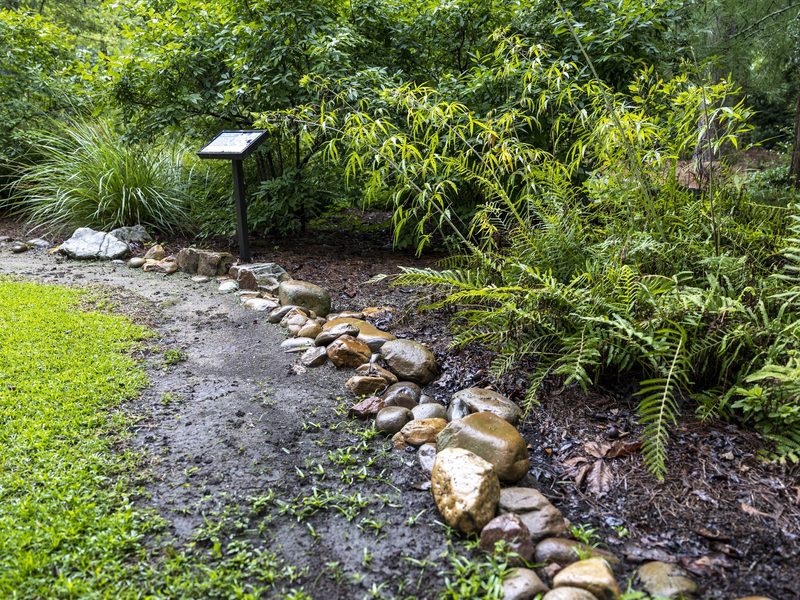
A creek bed can be built to carry storm water or simply to look as if it could. Our drainage solutions webpage lists it among the other drainage fixes. This guide covers the build itself, from the path to the plants.
Follow the fall of the ground
A Master Gardener tip sheet hosted by the University of Arkansas extension says a dry stream bed looks best when it follows an existing slope or change in elevation, even one that isn't a natural feature of the landscape.
The same sheet puts large boulders at the bends and uses them to disguise the headwaters, so the creek seems to come from somewhere instead of starting at a bare spot in the lawn.
How wide and deep should a dry creek bed be?
Wider than deep. The tip sheet says natural creek beds are usually wider than they are deep and that a ratio of 2 to 1 looks about right, so a bed about 4 feet wide would be dug about 2 feet deep.
That ratio is offered for looks. How much water a bed has to carry is a separate question, and it's one for the drainage plan before anyone picks up a shovel.
Which rock sizes, and where?
Mix them. Ask Extension says the stones can vary in size, with larger ones acting as stabilizers and smaller ones as fillers.
The tip sheet adds the placement. It calls for rocks, stones and gravel in a variety of shapes and sizes, with small and medium stones along the center of the channel and larger rocks and boulders along the edges and in the middle, set as if they're too heavy for the current to move.
Neither source gives stone sizes in inches, so there's no chart to follow.
Do you need landscape fabric under a dry creek bed?
Both extension sources here say yes. Ask Extension says to place tightly woven landscape fabric below the stone lining, and the tip sheet lines the channel with fabric to keep weeds from getting established.
The fabric can't be watertight. Another Ask Extension answer says it must be water permeable, so water can filter into the soil along the path.
Plants for the banks
The tip sheet favors native plants along the banks wherever possible, for a more natural look and less maintenance.
UGA Extension's Forsyth County office writes its plant list for rain gardens, not creek beds, and says rain garden plants must be tolerant of wet and dry conditions. Its suggestions include woody plants such as river birch, sweetbay magnolia and oakleaf hydrangea, and perennials such as aster, swamp milkweed, foam flower and canna lilies.
Our planting and flower bed work covers banks like these.
Where should a dry creek bed end?
Somewhere the water can go. LSU AgCenter says that depends on the property, and that on larger properties water can be sent to ponds, ditches, culverts and low areas.
Sending it to the street is another matter. The tip sheet says to check with local authorities and get any permits needed before redirecting water to the public stormwater system. Letting it soak in at the low end is the other route, and our drainage solutions webpage covers rain gardens.
Mortar, planting through fabric and the low end
Should the rocks in a dry creek bed be mortared?
When it will carry water, the Master Gardener tip sheet says yes: a stream bed used to carry water needs all its rocks mortared into place. Ask Extension's answer doesn't mention mortar, and says that generally, the heavier the flows, the larger the stones should be.
How do you plant through landscape fabric?
Cut an X in the fabric where the plant goes and set the plant into the soil beneath it, as the Master Gardener tip sheet describes. The fabric stays in place around the stem, so planting along the bed doesn't mean giving up the weed barrier.
What goes at the low end of a dry creek bed?
Fine gravel. The Master Gardener tip sheet says to spread it at the lower end of the dry stream bed to create the appearance of naturally deposited sediment, the way a creek drops its smallest stones where the water slows.