
Guides Landscape design ideas
Garden design principles for a yard that hangs together
Garden design rests on a handful of principles that extension designers teach under slightly different names: unity, balance, scale, rhythm through repetition, a focal point, and the line, texture and color that tie a yard together. None of them is a rule. Each is a way to make a yard look planned.
Updated November 15, 2026
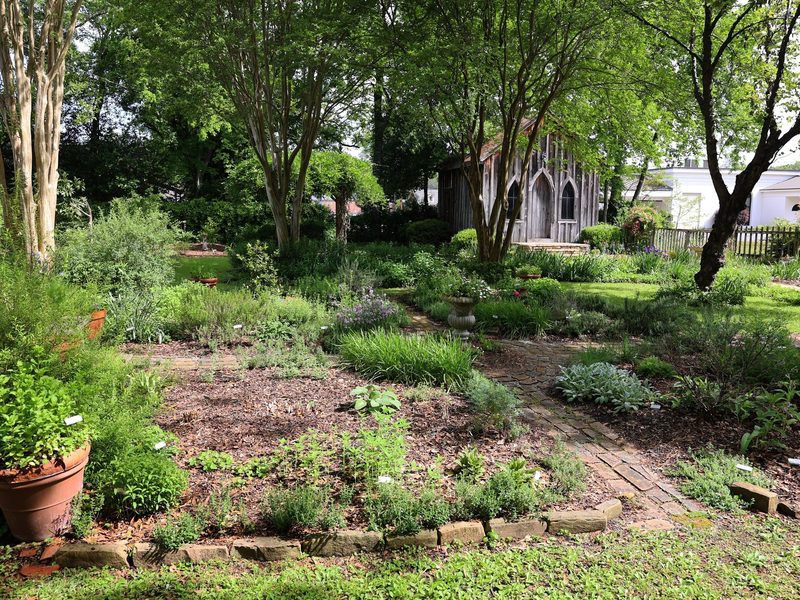
NC State Extension's handbook lists scale, balance, unity, perspective, rhythm and accent as fundamental concepts, and simplicity, repetition, line, variety and harmony as organizing principles. Penn State groups them a little differently, so each principle below follows the source that explains it best. Our landscape design webpage covers how a plan gets drawn; these principles are what make it look like one place.
Unity: one yard, not a collection
NC State says unity comes when the parts of a design are arranged to look like a single unit, and that a landscape with too many ideas in a small space lacks it.
Materials are an easy place to see it. Penn State Extension says matching hardscape materials to the house helps tie a garden together, and that a small garden using many different path materials, such as brick, flagstone and concrete, looks disjointed.
Why plant in groups instead of one of each?
Because simplicity reads as planned. NC State says simplicity strives to create spaces, not fill them, and that it's more effective to plant groups of one type of plant than to install one or two each of a wide variety of plants. Repetition, it adds, contributes to both unity and simplicity.
Symmetrical or asymmetrical balance?
Symmetrical balance is the formal kind. NC State describes it as everything on one axis, duplicated or mirrored on both sides. Picture matching shrubs on either side of a front door.
Asymmetrical balance works by weight instead of mirror images. NC State's example is a large existing tree or shrub balanced out by a grouping or cluster of smaller plants.
Scale and proportion
NC State defines scale as the proportion between two sets of dimensions, such as a tree's height and width compared with the house. Penn State puts it in front yard terms: if the house is tall, a front garden of only a few shrubs will look out of scale.
So plants get picked by their grown size against the house, not by how they look in a nursery row.
Rhythm comes from repetition
Penn State says rhythm doesn't exist without repetition, and the repeated element can be a color or a shape. The same plant or the same bloom color, recurring along a bed, carries the eye from one end to the other.
Where should a focal point go?
Where you want people to look. Penn State describes focal points as magnets that pull the viewer to a specific place in the garden. NC State's word for the same idea is accent, and the question about boulders below covers its warning.
Texture and color
Penn State says texture can provide interest and contrast, and that it comes more often from plant foliage than from hardscape. Fine leaves next to coarse ones make both stand out.
For color, UGA Extension's color basics sort red, orange and yellow as warm colors, associated with heat, fire and the sun, and green and blue as cool ones. Repeating one color through a bed is a simple way to put rhythm and unity to work at the same time.
Curves, small yards and boulders
Do curved beds look better than straight ones?
They feel different. Penn State Extension calls a curved line a soft, restful feature in a garden. Whichever line a bed takes, its edge also sets the shape of the lawn beside it, so the bed and the lawn are best drawn together.
Can planting make a small yard look bigger?
It can. Mississippi State Extension says cool colors recede and can make a small landscape look larger. NC State adds that distant objects look fine-textured and gray, so gray, fine-textured plants at the boundary make it seem farther away.
Are boulders a good focal point?
In moderation. NC State Extension says boulders are often used as accents but can be overused, and it warns that without any accent at all, a design may be static or dull.