
Guides Landscape design ideas
Hardscape vs landscape: the built and the growing
Hardscape vs landscape plays out in a yard as three trade-offs: what happens to the rain, how hot the ground gets in summer, and how much upkeep each part asks for. EPA puts numbers on the first two, federal highway engineers explain paving that lets rain through, and extension guides cover the upkeep.
Updated November 15, 2026
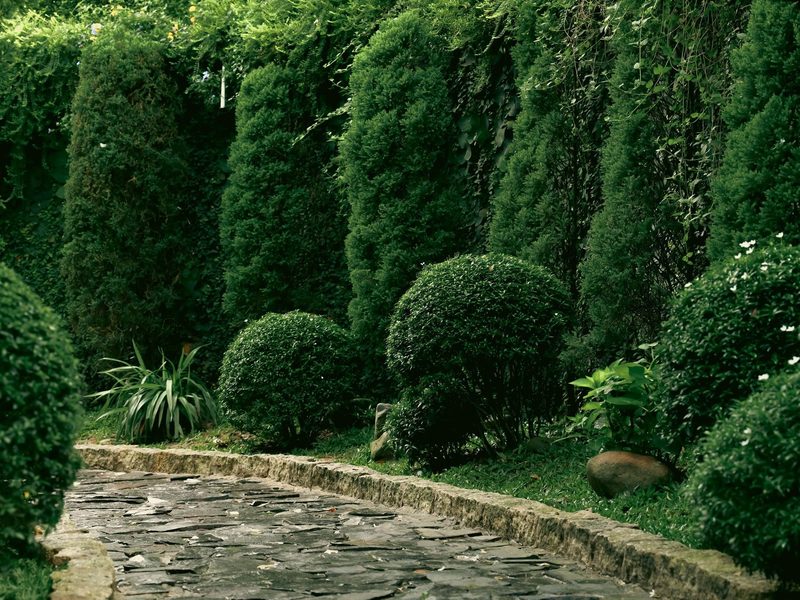
Our hardscaping webpage covers what counts as hardscape and how the built and planted parts of a yard share one plan. This guide picks up the practical differences between them.
What happens to the rain?
Paving sends it somewhere. Virginia Tech Extension sorts the ground into pervious surfaces like soil, mulch and vegetative groundcovers and impervious ones like roads, driveways and rooftops, and our hardscaping webpage covers the runoff the hard kind adds. EPA puts numbers on it, saying a typical city block, with its pavement and rooftops, generates more than five times the runoff of a woodland area the same size, and that as little as 10 percent impervious cover in a watershed can result in stream degradation.
A home lot is neither a city block nor a watershed, so neither number is a yard rule. Both point the same way, though: rain that lands on a patio or a walk runs on, where planted ground would have taken some of it in. Our drainage solutions webpage covers where that water can go.
Can paving let water through?
Some can. Virginia Tech says permeable pavement comes in plastic, rubber and asphalt, though concrete is most common. The Federal Highway Administration describes permeable interlocking concrete pavement as solid concrete units whose joints are filled with permeable aggregate, which lets water freely enter the surface. Underneath, the base and subbase store the water, and the patio materials guide covers what permeable paving does for runoff.
How fast it drains from there depends on what's underneath. Virginia Tech Extension notes that sandy soils infiltrate more quickly than clay soils under permeable pavement, which matters wherever the ground is clay. Our paver patios webpage covers how a standard patio base goes in.
How hot does paving get?
Much hotter than the air. On a hot, sunny summer day, EPA says, the sun can heat dry, exposed surfaces like roofs and pavement to 50 to 90 degrees Fahrenheit hotter than the air.
That's the case for shade over a patio, and the backyard patio ideas guide covers where it falls through the afternoon.
Which needs more upkeep?
It depends on what's planted and what's paved. On the planted side, UGA singles out the lawn, and the xeriscape guide covers what it says about turf's upkeep and water.
Permeable paving has its own routine. Virginia Tech says to sweep or use a blower weekly to remove debris, and to replace plants, sand or gravel in grid or interlocking pavers as needed.
How much of a yard should be paved?
There's no percentage for a home yard in any of the extension or federal guides quoted here. The closest thing to a rule is balance, the University of Florida's advice on our hardscaping webpage, and EPA's 10 percent figure describes whole watersheds, not single yards.
Where the line falls is a design question, and our landscape design webpage covers how a plan settles it.
Sealing, shade and trees
Should a permeable patio be sealed?
Not if it's pervious concrete or porous asphalt. Virginia Tech Extension says to avoid sealing those two surfaces, even though sealing is often done to renew a surface. Its warning is about those two, not every kind of paving.
Why does a planted yard feel cooler than a patio?
Plants cool the air around them. EPA says trees and vegetation cool the air by providing shade and by transpiring water from their leaves, two things bare paving can't do. A shade tree or a planted edge beside a patio puts both to work.
How close can paving go to a tree?
Our backyard patio ideas guide answers that one, with UGA's way to size a tree's root zone from its trunk and Clemson's list of what kills trees during construction. Read it before any paving goes near a tree you'd like to keep, because a patio on paper is far easier to move than a grown tree.