
Guides Landscape design ideas
Front yard landscaping ideas for a Georgia home
Front yard landscaping ideas work best when they start at the front door: a walk that gets people there, foundation beds sized for shrubs at their full grown size, trees placed where their shade does the most good, and a lawn shaped so it's easy to mow.
Updated November 15, 2026
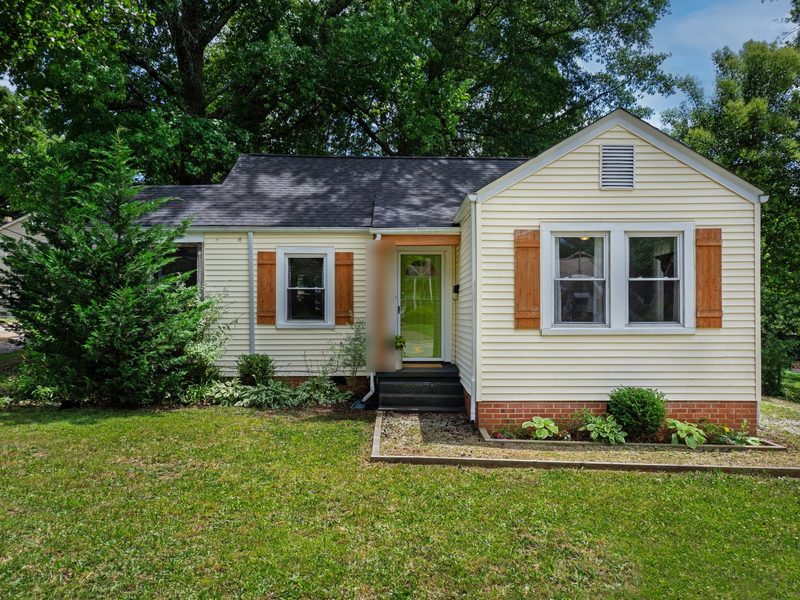
Here's what goes into a front yard plan, with the measurements extension designers use, so a plan that looks right on paper still fits once the plants grow up. The drawing itself is the subject of our landscape design webpage.
How far from the house should shrubs go?
Measure by the grown shrub, not the one in the pot. NC State Extension says knowing a plant's mature size is critical for spacing, and its rule for plants near a building is half their mature width plus at least 1 foot from the structure. A shrub that grows 5 feet wide goes 3.5 feet out from the wall.
Once the spacing is set, height decides the order. Mississippi State Extension's advice for foundation and bed plantings is to layer the shrubs by their height, from highest to lowest.
Which plants suit a north Georgia front yard?
The ones that still fit the spot once they're grown. Our plant guides cover shrubs and trees that suit front beds here: azaleas, camellias, hydrangeas and crepe myrtles, plus deer-resistant plants for yards where deer browse and ground covers for shady strips where grass struggles.
For cold hardiness, the Georgia planting zones guide has the map.
A walk that leads to the door
Don't make guests hunt for the door. Alabama Extension's advice for the public area is to keep it simple and uncluttered and to focus guests' attention on the front door, and it says a walk leading from the drive to the front door will guide them there.
The walk itself should offer a fairly direct path, Alabama Extension says, with perhaps a few slight curves for interest. Unless you want a formal effect and guests park on the street, it advises against a walk down the middle of the front yard.
How wide to build it is on our walkways and steps webpage, along with the step dimensions Georgia's residential code sets.
Where should front yard trees go?
Where their shade lands on the house. The US Department of Energy says tall deciduous trees with high, spreading branches belong on the south side of a house, for the most summer shade over the roof. On a house that faces north, those trees belong in the backyard instead.
On the west side, where the afternoon sun is the problem, it favors trees with leaves and branches lower to the ground. The backyard patio ideas guide covers the afternoon side in more detail, and the fast growing trees guide sorts the shade trees worth planting from the short-lived ones.
Less lawn, easier lawn
A front lawn is easiest to keep when its shape is simple. NC State Extension says to avoid sharp angles, tight corners, narrow lawns and irregular edges that are hard to mow and water.
There's also the option of shrinking it. Our xeriscape guide covers trading turf for planted beds, and putting in those beds is planting work we do.
Moisture, quick shade and power lines
Should foundation shrubs touch the house?
No. NC State Extension warns that too many trees and shrubs near the house can cause moisture problems that lead to mildew, mold and high humidity. It adds that the wind and the sun should periodically dry the area around the home.
How soon will a new tree shade the house?
Sooner for the windows than for the roof. The US Department of Energy says deciduous trees 6 to 8 feet tall, planted near a house, will begin shading windows the first year. A slow-growing tree, it adds, may need up to a decade of growth before it shades a roof.
What can grow near an overhead power line?
Virginia Tech sorts the ground by distance from a distribution line: under 20 feet, 20 to 50 feet, and over 50 feet. It says trees in that closest zone typically shouldn't exceed 25 feet at maturity. It's a Virginia guide, so ask the power company before planting near a line.