
Guides Plants for Georgia yards
Privacy trees for Georgia yards
Privacy trees in Georgia often mean Leyland cypress, which UGA says has become one of the most widely used screen plants in the state. It grows fast, but it needs at least 15 feet between trees and is prone to disease when crowded, so NC State Extension's alternatives, like Japanese cedar, are worth a look.
Updated November 15, 2026
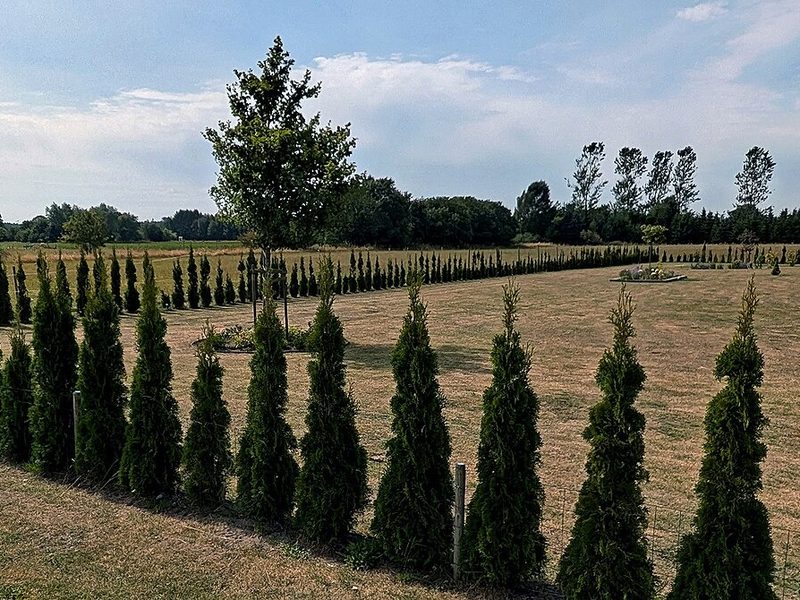

Most of the trees in this guide get big. UGA puts Leyland cypress at up to 50 feet tall and 30 feet wide, and among the NC State Extension alternatives below, heights run from 35 feet for Carolina cherry laurel to as much as 70 feet for Japanese cedar. So when you plan a screen, the mature width counts too, because it decides how much room each tree needs.
What goes wrong with Leyland cypress, and what grows instead?
Nothing, at first. UGA calls Leyland cypress a graceful, rapidly growing evergreen adapted to USDA zones 6 to 10a, and it has become one of the most widely used plants across Georgia as a hedge, screen, buffer strip or wind barrier. A UGA news story says it grows 3 to 4 feet a year.
The trouble starts with how it's planted. The same story says these trees need at least 15 feet from the center of one tree to the center of the next, yet they're commonly set far closer than that, in straight lines.
Crowding sets up disease. UGA says that because Leyland cypress is often planted too close together and in poorly drained soils, it's prone to root rot and several damaging canker diseases, especially during long droughts. In Georgia, Seiridium canker is probably the most important and destructive disease of the tree in the landscape.
Two more UGA findings shape the plan. Adequate irrigation during drought is the best defense against Seiridium canker, and no cultivar or selection is known to resist it. A screen on drip irrigation is easier to keep watered through a dry spell, and a soggy strip may need drainage work before any tree goes in. We plant privacy screens as part of landscape installation.
As for what grows instead, NC State calls Japanese cedar, or Cryptomeria, a great alternative to Leyland cypress for screening, and the next section covers it with four other evergreens.
Evergreens to plant instead of Leyland cypress
Each description here comes from NC State Extension's Plant Toolbox:
- Japanese cedar (Cryptomeria): may reach 50 to 70 feet tall and 20 to 30 feet wide, with a conical to pyramidal shape.
- Green Giant arborvitae: resists most diseases, insects, periodic droughts and deer. NC State warns that, like Leyland cypress, it can quickly grow very large and become a problem in a space too small for its full size, and that it occasionally gets bagworms and can get root rot in poorly drained soil.
- American holly: grows slowly to 40 to 60 feet tall and 10 to 20 feet wide, and NC State calls it ideal for privacy screens, barriers and hedges. It's highly deer resistant, too.
- Eastern red cedar: does well as a screen or windbreak, and NC State says to plant it 12 to 24 feet apart.
- Carolina cherry laurel: grows rapidly to 35 feet tall and 15 to 20 feet wide, though white-tailed deer browse its foliage.
Those are North Carolina descriptions, so check each tree against your own spot and your planting zone before you buy. If deer pass through, our deer resistant plants guide covers the lower layers of the yard.
How far apart should privacy trees be planted?
Farther than it looks on planting day. For Leyland cypress, UGA's number is at least 15 feet from center to center, and NC State's spacing for Eastern red cedar is 12 to 24 feet.
For the others, the mature width tells you the scale. A Japanese cedar that spreads 20 to 30 feet needs far more room than an American holly at 10 to 20 feet, and a cherry laurel at 15 to 20 feet falls in between.
Speed differs, too. Leyland cypress grows 3 to 4 feet a year by UGA's count, NC State says cherry laurel grows rapidly, and American holly grows slowly, so a holly screen asks for more patience. The trade-offs of fast growth get their own look in our fast growing trees guide.
Leyland speed, disease and deer
Is there a Leyland cypress that resists disease?
Not for Seiridium canker. UGA says no Leyland cypress cultivars or selections are known to be resistant to it, and that adequate irrigation during drought is the best defense. Giving the trees room and well-drained soil matters too, since crowding and poor drainage leave them prone to disease.
How fast does Leyland cypress grow?
UGA puts it at 3 to 4 feet a year, on the way to as much as 50 feet tall and 30 feet wide. That speed is the appeal, and that size is why UGA says the trees need at least 15 feet from center to center.
Which privacy trees do deer leave alone?
NC State Extension says Green Giant arborvitae resists deer and calls American holly highly deer resistant. Carolina cherry laurel is the one to watch, because NC State notes that white-tailed deer browse its foliage. No plant is fully deer proof, though.