
Guides Fire pits, patios and outdoor living
Backyard patio ideas that fit the yard
Backyard patio ideas have to fit the people using the patio and the yard around it. Size, shade, trees and slope shape them more than the paving does.
Updated November 15, 2026
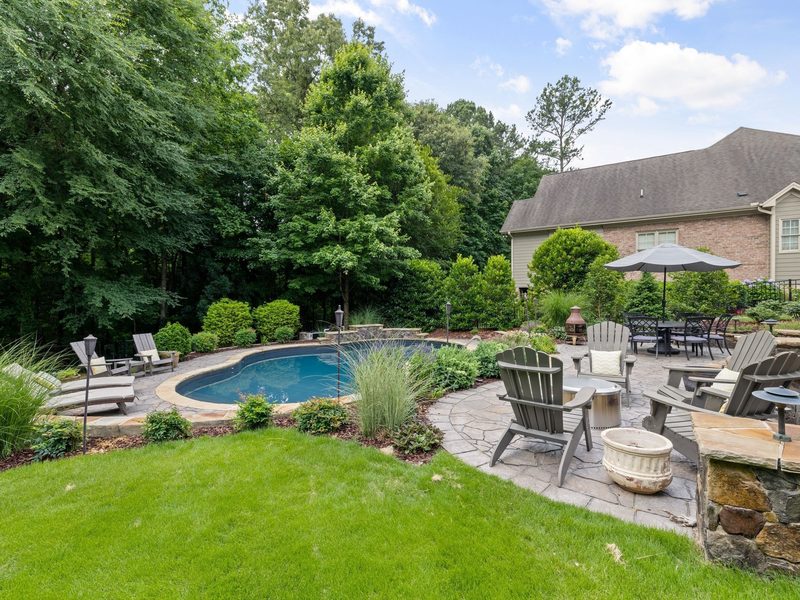
Build it bigger than feels necessary, put it where something shades it from the afternoon sun, keep it clear of the roots of any big tree you want to keep, and on a slope, plan the walls and steps along with it. The surface comes after those four, and for any of these backyard patio ideas, the patio materials guide compares the options.
How big should a backyard patio be?
Big enough for the furniture and the people. NC State Extension's design handbook says it's better to build a patio too large than too small, and that a patio for entertaining should comfortably hold the most guests who'll use it.
University of Florida Extension's design guide leans the other way. Quoted on our hardscaping webpage, it sizes paving to the activity and stops there.
Both views start with a tape measure. NC State suggests measuring the outdoor furniture you plan to use and allowing 2 to 3 feet of walking room around the chairs, so people can push back from the table and still get past.
A patio that does two jobs, dinner on one end and a fire on the other, needs room for both circles; the fire pit ideas guide covers the seating side of that.
Where does a patio get afternoon shade?
On the west side of something tall. NC State Extension says deciduous trees give the most benefit on the western side, where they shade the home from noon to sunset in summer and let winter sun through, and it notes some benefit to planting on the east side to shade from sunrise to noon.
The house casts afternoon shade of its own. A patio off the east side of the house sits in that shade in the afternoon, while one off the west wall takes the full afternoon sun.
NC State also suggests planting trees to shade a patio in summer. Where there's no room for a tree, a vine on a pergola does a similar job, and the pergola ideas guide covers the native vines to grow on one.
Can a patio go near a big tree?
It can, if it stays off the roots that matter. UGA Extension's Bartow County office says changing the soil grade around existing tree roots, even by a few inches, can cause permanent damage.
Roots grow closer to the surface in clay soils than in sandy ones, it adds, and more than an inch of clay fill starts root damage.
UGA's office gives a way to size the area to protect. Measure the trunk's diameter 4.5 feet off the ground and multiply that number by 2.5; the result is the diameter of the root protection zone in feet. Its example is an oak with a 20-inch trunk, which gets a 50-foot zone.
That's a big circle, and UGA says a tree's survival is affected once 20 to 30 percent of its critical rooting zone is damaged.
Clemson Extension names the three main causes of tree death during construction: soil compaction, grade changes and root severing. Its advice is to decide where the patio goes with the trees you're keeping in mind.
Patio ideas for a sloped backyard
On a slope, a patio usually comes with a wall. UGA Extension's Forsyth County office says retaining walls and terracing secure soil and create level planting areas on a slope.
The same approach makes level ground for a patio: a wall holds the high side, and the patio sits on the flat ground behind it.
Steps tie the levels together. Our retaining walls and walkways and steps webpages cover the walls and the stairs between levels, and a stepping stone path can finish the route across the lawn below.
Roots, delayed damage and steep yards
Can a patio go over tree roots?
It's risky. UGA Extension's Bartow County office suggests a raised walkway or bridge over the rooting zone instead of a sidewalk or road, which keeps paving off the roots. For a patio, the simpler answer is usually to move it outside the zone and reach it with a path.
Does tree damage from building show up right away?
Often not. UGA Extension's Bartow County office says decline from soil compaction may take three to seven years to appear. By the time a tree beside a new patio starts thinning, the damage is long done, which is why the planning comes before the digging.
What counts as a steep backyard?
Mississippi State University Extension defines steep slopes as land that rises at more than 20 percent. On ground that steep, a patio usually needs a retaining wall or terracing to give it a level place to sit.