
Guides Fire pits, patios and outdoor living
Patios: comparing the surfaces
Patios can be poured concrete, concrete pavers, brick, flagstone or gravel, and each one handles Georgia heat, rain and shade its own way. The differences show up in how a surface cracks, stains, drains and holds the afternoon sun.
Updated November 15, 2026
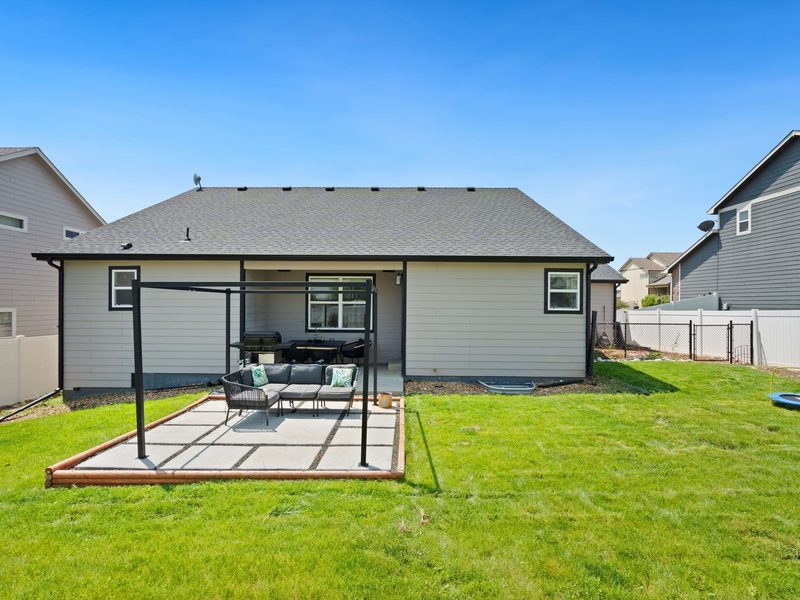
Patios mostly fall on one side of a big split: one continuous surface or many separate pieces. Concrete goes down as a single slab, while pavers, brick and flagstone are laid piece by piece on a prepared base. Gravel is the loose option. Each one trades something, whether that's cracking, upkeep, drainage or summer heat.
Why does a poured concrete patio crack?
Because concrete moves. The National Ready Mixed Concrete Association (NRMCA) says concrete expands and shrinks with changes in moisture and temperature. It adds that cracks in concrete can't be prevented entirely, only controlled and kept small with properly designed joints.
Those joints are the straight grooves you see across a slab. NRMCA calls them pre-planned cracks: they give the slab a line to crack along, so the crack follows the groove.
Concrete still earns its place. NC State Extension's design handbook says aggregate concrete makes excellent terraces and patios. A paver patio handles the same movement in a different way, which our paver patio webpage explains, along with building on soft clay.
Pavers, brick and flagstone: pieces on a base
Building with separate pieces is the other approach. NC State Extension says laying brick on sand, with or without mortar, is an acceptable landscape practice.
With concrete pavers, upkeep is mostly about stains. Oregon State University Extension says sealing pavers helps prevent stains from oil, grease, grime, rust, moss, algae and everyday spills, the kind of marks a grill and a shady corner tend to leave.
Flagstone is natural stone split into flat slabs, and it isn't uniform. NC State's Natural Learning Initiative says flagstone typically comes in thicknesses from 1 to 4 inches, so ask what a supplier has before settling on how it'll be set. For flagstone underfoot on a path, see our walkways and steps webpage.
Is a gravel patio a good idea?
It can be, as long as it has an edge. UF Extension's walkway guide says loose materials like gravel need edging to keep them from wandering out of the path.
Gravel's strength is what it does with rain. NC State Extension's handbook suggests permeable paving for patios, such as gravel or pavers with open centers planted with grass. EPA adds that permeable pavements can let stormwater soak into the pavement and soil, which reduces runoff and filters pollutants.
That makes gravel a good fit for a casual sitting spot at the edge of the yard. Where chairs slide in and out at a dining table every evening, pavers or stone are easier to live with.
Which patio surface stays cooler in summer?
The one that reflects more sun. EPA describes cool pavements as paving materials that reflect more solar energy, help water evaporate, or have otherwise been modified to stay cooler than conventional pavement.
EPA's numbers come from a hotter place than Rome. In an Arizona pilot, asphalt reached surface temperatures up to 152°F at midday, while the cool pavements stayed 10 to 16 degrees cooler. A Georgia patio won't see desert heat, but the lesson carries: a more reflective surface stays more comfortable underfoot in July.
Placement does the rest. Where the patio sits, and what shades it, decides how much sun it takes in, and our backyard patio ideas guide covers where the afternoon shade falls.
Joints, moss and permits
How far apart should the joints in a concrete patio be?
NRMCA's guidance puts the maximum joint spacing at 24 to 36 times the slab's thickness. Its own example is a 4-inch slab, which gets a joint about every 10 feet. That's a maximum, so joints can sit closer together than that.
Why do pavers in the shade turn green or chalky?
Damp shade is hard on them. Oregon State University Extension says pavers in shaded or damp areas are prone to efflorescence, which is chalky salt deposits, and to moss build-up, and it says that's where resealing is needed most.
Does a patio need a permit in Rome?
It depends on the patio. Inside the city limits, Rome's building FAQ lists uncovered concrete patios among the minor improvements that typically don't need a permit, while patio covers are on its list of projects that do. Outside the city, or for anything else, ask before building.