
Guides Fire pits, patios and outdoor living
Pergola ideas for Georgia patios
Pergola ideas in Georgia start with what grows on top. A pergola gives a vine a frame to climb, and the right native vine turns those open beams into shade over the patio.
Updated November 15, 2026
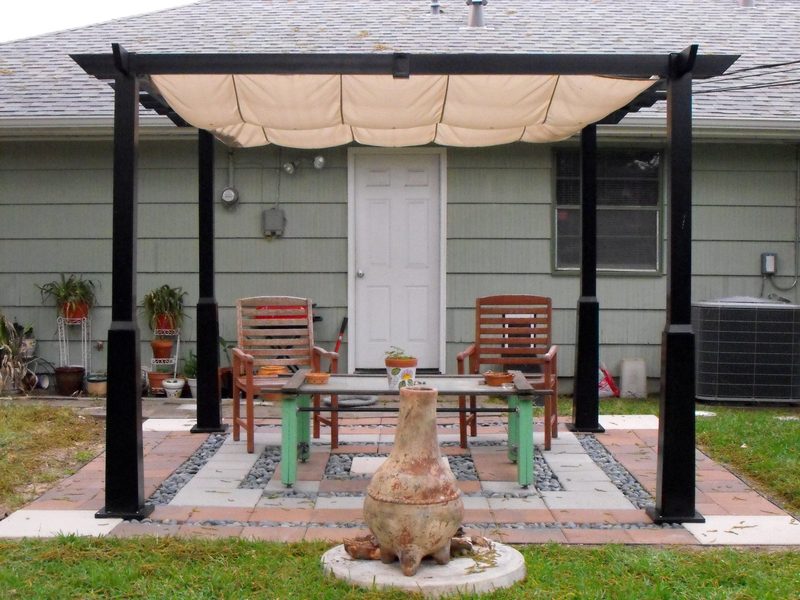
The short version of most good pergola ideas: set the pergola where you want shade, grow a native vine over it, and keep the invasive wisteria and honeysuckle off it. UGA Extension's native plant bulletin suggests crossvine, trumpet honeysuckle, Carolina yellow jessamine and American wisteria for structures like arbors, trellises and fences.
How much shade does a pergola give?
On its own, a pergola gives the striped shade of its beams. With a vine across the top, it gives far more. NC State Extension's design handbook, writing about shade and energy savings, says trees, shrubs and vines are all effective, with one condition: vines need an arbor or trellis to climb.
The same handbook says to shade outdoor seating areas, walls and hardscapes, not only the house. A pergola over a patio does that in places where a tree won't fit.
The vine also sets the winter look. UGA Extension's DeKalb County office lists trumpet honeysuckle and American wisteria as deciduous, so a pergola covered in either one lets more winter sun reach the patio below.
Native vines for a Georgia pergola
All four of these come from UGA's bulletin on native plants for Georgia, the volume covering trees, shrubs and woody vines:
- Crossvine: UGA calls it a good plant for quickly covering trellises and fences, and says it needs training for its first few years after transplanting.
- Trumpet honeysuckle (Lonicera sempervirens): UGA suggests it for arbors, trellises, fences and walls. It does best in moist, fertile soil and full sun, and UGA says it isn't aggressive and stays in bounds with regular pruning.
- Carolina yellow jessamine: UGA lists it for trellises and fences and notes it may need training.
- American wisteria (Wisteria frutescens): UGA suggests it for arbors, trellises, fences and walls.
Training here means guiding the young stems up the posts until they reach the top, where the vine can spread across the beams.
Which wisteria and honeysuckle should stay off a pergola?
The imported ones. UGA Extension's DeKalb County office lists Chinese wisteria and Japanese honeysuckle as category 1 invasive plants, the category for the plants that are hardest to remove and do the most harm in their new, non-native surroundings.
The common names overlap, so check the botanical name on the tag. American wisteria is Wisteria frutescens; Chinese wisteria is Wisteria sinensis. Trumpet honeysuckle is Lonicera sempervirens; Japanese honeysuckle is Lonicera japonica.
Where a pergola fits in the yard
A few placements that tend to work:
- over the dining end of a patio, where afternoon shade counts most;
- over a garden walk or gate, as an entry the vine can frame;
- beside an outdoor kitchen, with the grill kept out from under the vines (the outdoor kitchen ideas guide has the clearance USFA asks for).
Where the pergola stands decides what can grow on and around it, and our landscape design work covers that planting side.
Fire is the one thing to keep out from under it. The fire pit ideas guide covers how much open air Smokey Bear wants above a fire.
Permits, partial shade and American wisteria
Does a pergola need a permit in Rome?
Ask first. Inside the city limits, Rome's permit FAQ puts gazebos and patio covers on its list of work that requires a building permit. A pergola isn't named, so check with the city's building inspection office, especially for one attached to the house or topped with a solid cover.
Which pergola vines handle partial shade?
Carolina yellow jessamine prefers moist, well-drained soil in full sun or partial shade, UGA Extension says. UGA's DeKalb County office lists trumpet honeysuckle for sun to part shade and American wisteria for sun to shade, so all three can work on a pergola that gets only part of the day's sun.
Is American wisteria invasive like Chinese wisteria?
Far less so. UGA Extension says American wisteria is not nearly as aggressive or invasive as the exotic wisterias, and it calls the native a much better choice for the landscape.