
Guides Fire pits, patios and outdoor living
Outdoor kitchen ideas for Georgia summers
Outdoor kitchen ideas for a Georgia yard have to work in July heat. A useful one can be small: a grill, counter space beside it, a safe spot for both, and a plan for keeping food safe when it's 90 degrees out.
Updated November 15, 2026
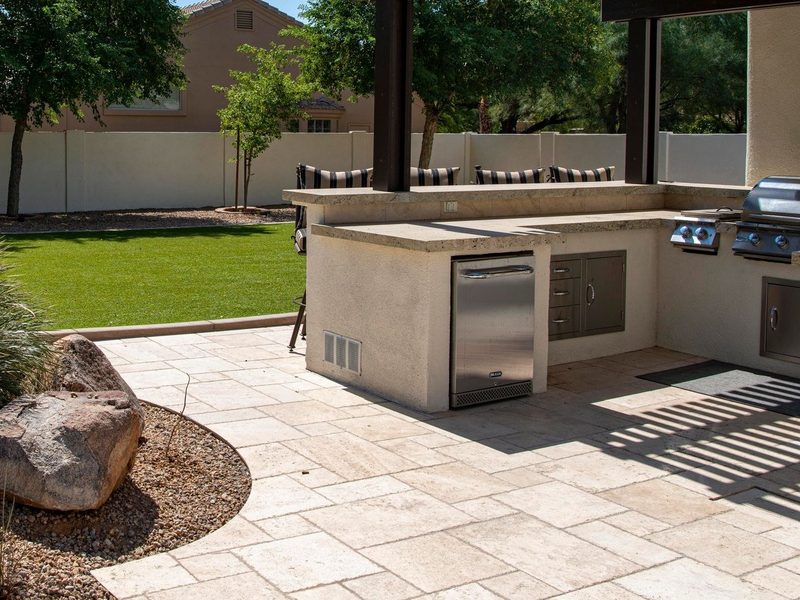
Start small and safe. A grill set into a counter, room to prep and serve on either side, and storage that saves trips back inside cover most backyard cooking. In Georgia's heat, the bigger decisions are where the grill sits and how long food can stay out, and federal fire and food safety agencies answer both.
Small outdoor kitchen ideas
A small yard can still have a real cooking station. A few layouts that fit tight spaces:
- A grill station: the grill set into a short counter, with landing room on each side for a platter and tools.
- One wall: grill, counter and storage in a single row along the patio's edge, so the middle of the patio stays open for the table.
- A corner L: two short runs of counter meeting at a corner, with prep space on one side of the grill and a serving ledge on the other.
- Something besides a grill: a smoker, a griddle or a pizza oven as the centerpiece, with the same counter idea built around it.
Whatever the layout, the counter is what turns a grill on a patio into a kitchen. Our outdoor kitchen webpage covers what goes into a full build and the materials that hold up outside, and the floor under it is paver patio work.
How long can food sit out in Georgia heat?
An hour, once it's above 90 degrees. FoodSafety.gov says perishable food shouldn't sit out of refrigeration for more than 2 hours, and when it's exposed to temperatures above 90°F, as at a summer picnic, it should go into the refrigerator within 1 hour. Plenty of Rome cookouts happen in that kind of heat.
The reason is the range in between. FoodSafety.gov says the bacteria that cause food poisoning multiply quickest between 40°F and 140°F, which is right where a platter of cooked burgers sits on a counter on a warm evening.
That's a good argument for an outdoor refrigerator, or at least a cooler in the shade within reach of the grill, and for carrying leftovers inside early.
Cooking meat to a safe temperature
FoodSafety.gov says to always use a food thermometer to check that meat has reached a safe minimum internal temperature, one hot enough to kill the germs that cause food poisoning. Illinois Extension, summarizing USDA guidance for grilling season, lists these:
| Food | Safe minimum internal temperature |
|---|---|
| Beef, pork, veal and lamb steaks, roasts and chops | 145°F, followed by a 3-minute rest |
| Ground beef, pork, veal and lamb | 160°F |
| Poultry of all types, including ground | 165°F |
The same Illinois Extension advice adds one more rule: never partially grill meat or poultry with the plan to finish it later.
Where should the grill go?
USFA, the U.S. Fire Administration, says to place a grill at least 3 feet from siding, deck railings, eaves and overhanging branches. That rules out tucking it under the edge of the house's roof, and it's a reason to keep a vine-covered pergola from hanging over the grill. Our outdoor kitchen webpage adds NFPA's advice, which leaves the exact clearance to the grill's manual.
Gas grill checks before the first cookout
CPSC, the Consumer Product Safety Commission, suggests two checks on a gas grill. First, look over the hoses for cracking, brittleness, holes and leaks. Then open the gas supply valve fully, brush a soapy solution onto the connection point and watch: bubbles mean a leak.
A grill built into a counter makes those connections harder to reach, so plan an access door where the hose meets the tank or the gas line.
Flare-ups, platters and roofs
What should you do if grease flares up on the grill?
Smokey Bear's grilling guidance says to turn off the burners or fuel source if it's safe to do so, then close the grill lid, which smothers the flames by cutting off their oxygen. A lid that's easy to reach is one more reason to keep the grill area clear.
Do raw and cooked meat need separate plates?
Yes. FoodSafety.gov says to use separate plates and utensils for cooked and raw foods. The platter that carried raw burgers out to the grill shouldn't carry the cooked ones back, so plan counter space for two.
Does a roof over an outdoor kitchen need a permit in Rome?
Ask before building one. Inside the city limits, Rome's permit FAQ lists gazebos and patio covers among the projects that need a building permit, and a kitchen roof isn't named on its own. The city's building inspection office can say whether one counts before the posts go in.