
Guides Grass and sod
How to lay sod, step by step
To lay sod, get the soil graded, loosened and lightly damp first, then start along a straight edge and push each piece tight in staggered rows, UGA says. Water within 30 minutes of laying it, and keep the sod moist every day until it roots, which takes about 2 weeks.
Updated November 15, 2026
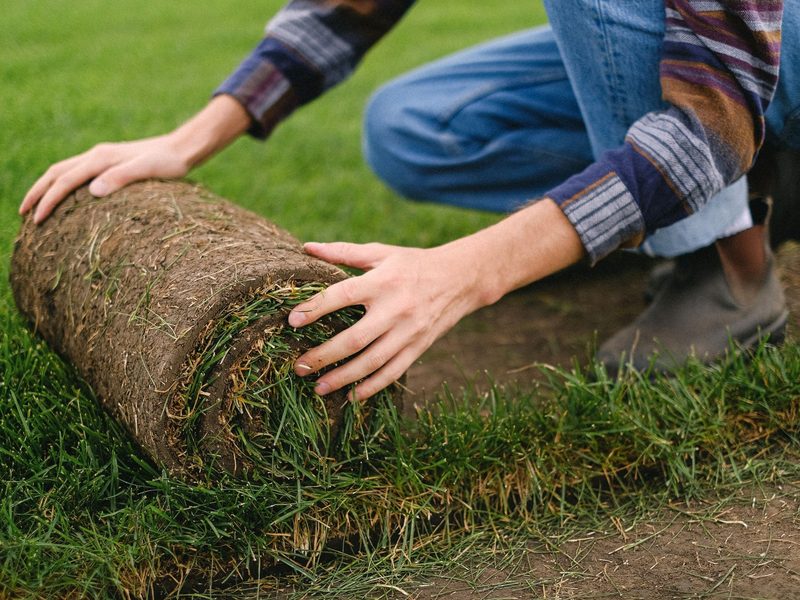
Sod is perishable, Texas A&M Extension says, and the clock starts at harvest. Texas A&M puts the limit at 36 hours, less in hot weather, and a UGA turfgrass specialist puts it at 48. That's why the soil gets ready before the pallets arrive, not after.
Timing depends on the grass. UGA's Fulton County office names May through August as the best stretch for warm-season sod. For tall fescue, UGA's establishment bulletin favors September and October, and the Fulton office adds February.
Getting the soil ready before the sod arrives
- Test the soil. A UGA county agent's checklist for sod starts with collecting soil samples for testing.
- Clear the site. UGA says to remove rocks, tree stumps, construction trash and other debris, since stumps left in place eventually decay and leave dips in the lawn. The same county agent adds treating weeds with a broadleaf herbicide labeled for the grass going in.
- Set the grade. UGA says to be sure the grade is right before sod goes down. Where a lot is regraded, UGA's figure for good surface drainage is a 1- to 2-percent fall away from every building, or a 1- to 2-foot drop per 100 feet.
- Work the soil. A UGA turfgrass specialist says to till amendments into the top 3 to 4 inches, then level and smooth the surface. UGA's establishment bulletin holds the final grading and the fertilizer mixing until right before planting.
- Firm it if it's sandy, then dampen it. On sandy soils, UGA says to firm and roll the bed so the soil just under the surface doesn't dry out too fast. Then water lightly before laying, without saturating the ground, since wet soil ruts under feet and equipment.
Grading a lot with real slope or low spots is a job for our yard grading service, and the whole installation, from prep through the first watering, can go to our sod installation service instead.
Laying the rows: staggered seams, tight edges
Stack the pallets out of the sun while you work, since UGA says sod that gets hot is damaged. Then:
- Start along the longest straight line on the site, such as a driveway or sidewalk.
- Push each piece's end snug against the last one without stretching it, leaving no gaps and no overlaps.
- Stagger the joints from row to row, the way bricks are laid, and trim corners and curves with a large, sharp knife.
- Stay off the sod as it goes down; UGA says walking or kneeling on it while it's being installed roughens the surface and leaves air pockets.
- Roll the whole area once it's down, for firm sod-to-soil contact and no trapped air.
Slopes need two more steps. UGA says to lay the pieces across a slope, perpendicular to it, and NC State Extension adds pegging or staking each piece so it can't slip downhill.
How often should new sod be watered?
Every day at first. UGA's schedule runs like this:
- Within 30 minutes: a first soak of a quarter to half an inch of water.
- The first 2 weeks or so: a light watering each day, plus extra whenever the sod starts to dry, until the roots have a firm hold. UGA's general guidance for new lawns puts the daily amount at an eighth to a quarter inch for the first 2 to 3 weeks.
- After that: water less often but deeper, wetting more of the soil as the roots grow.
UGA's Fulton County office goes further and says to water new seed or sod daily for the first 30 days, and the state's rules allow for that. EPD's standing schedule permits daily outdoor watering, for anyone, between 4 p.m. and 10 a.m., and it lets new plants, seed or turf be watered at any time of day during installation and for a full 30 days afterward.
A drought response level can tighten those rules. The level changes, so check EPD's drought webpage for the current one before the sod is delivered.
When can new sod be mowed?
Mow by height, not by the calendar. Its rule for new grass is to mow once it reaches 1.5 times its recommended height, and its establishment bulletin says to mow newly laid sod at the upper end of that grass's range.
Don't mow it wet, though. UGA warns that mowing wet sod can scalp it and damage the grade you worked to set.
Each grass's range is in its own guide: bermuda grass, zoysia, centipede grass and tall fescue. For what the sod itself costs, see the sod installation cost guide.
Sod sizes, certification, topsoil and traffic
How big is a piece of sod?
It depends on the farm's cutting machine. Purdue Extension gives typical sizes of 18 by 24 inches for slabs and 18 inches by 6 feet for rolls, and it also lists a 24-inch by 5-foot roll. Purdue puts sod's weight at about 35 to 40 pounds per square yard.
What does certified sod mean?
UGA says certified sod is true to type, meaning you get the grass you ordered, and free of noxious weeds such as nutsedge and of other contaminating grasses. UGA points buyers to GeorgiaCrop.com for it. On a new lawn, that's one less weed problem to inherit.
Does new sod need topsoil under it?
It needs workable soil, which isn't always new topsoil. UGA's guidance for a new lawn calls for at least 12 inches of topsoil on steep slopes and over rock outcrops, and it describes tilling compost into the top 4 inches as a soil improvement. Sand isn't one of them: UGA doesn't recommend sand as an amendment to Georgia soils.
When can new sod handle foot traffic?
UGA says to keep a new lawn free of heavy use for 3 weeks while the roots take hold. Walking on sod just after it's been watered is the other thing UGA warns against, since footprints in wet sod leave a rough surface and air pockets.